Aersynx aggregates airworthiness directives, life-limited parts, hard-time components, LDND tasks, MEL/CDL items, certificates, and lease events into a single per-aircraft timeline — built for the teams responsible for continuing airworthiness.
Modules share data. Status is always current. Nothing falls through the gap between tools — by design.
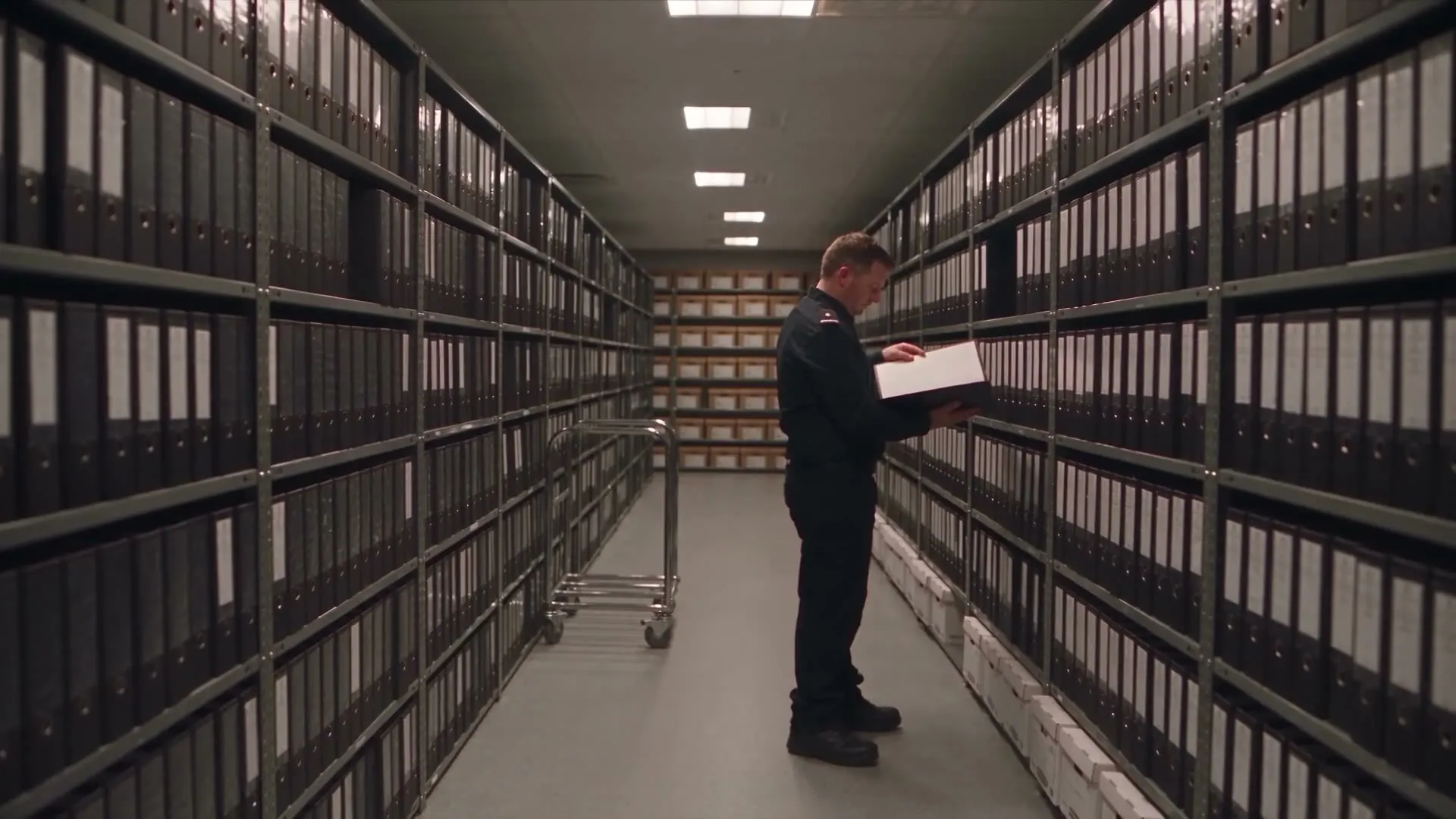
Binder and event-based technical records with per-item inspector review, OCR extraction, and controlled finding workflow. Every document signs an audit trail.
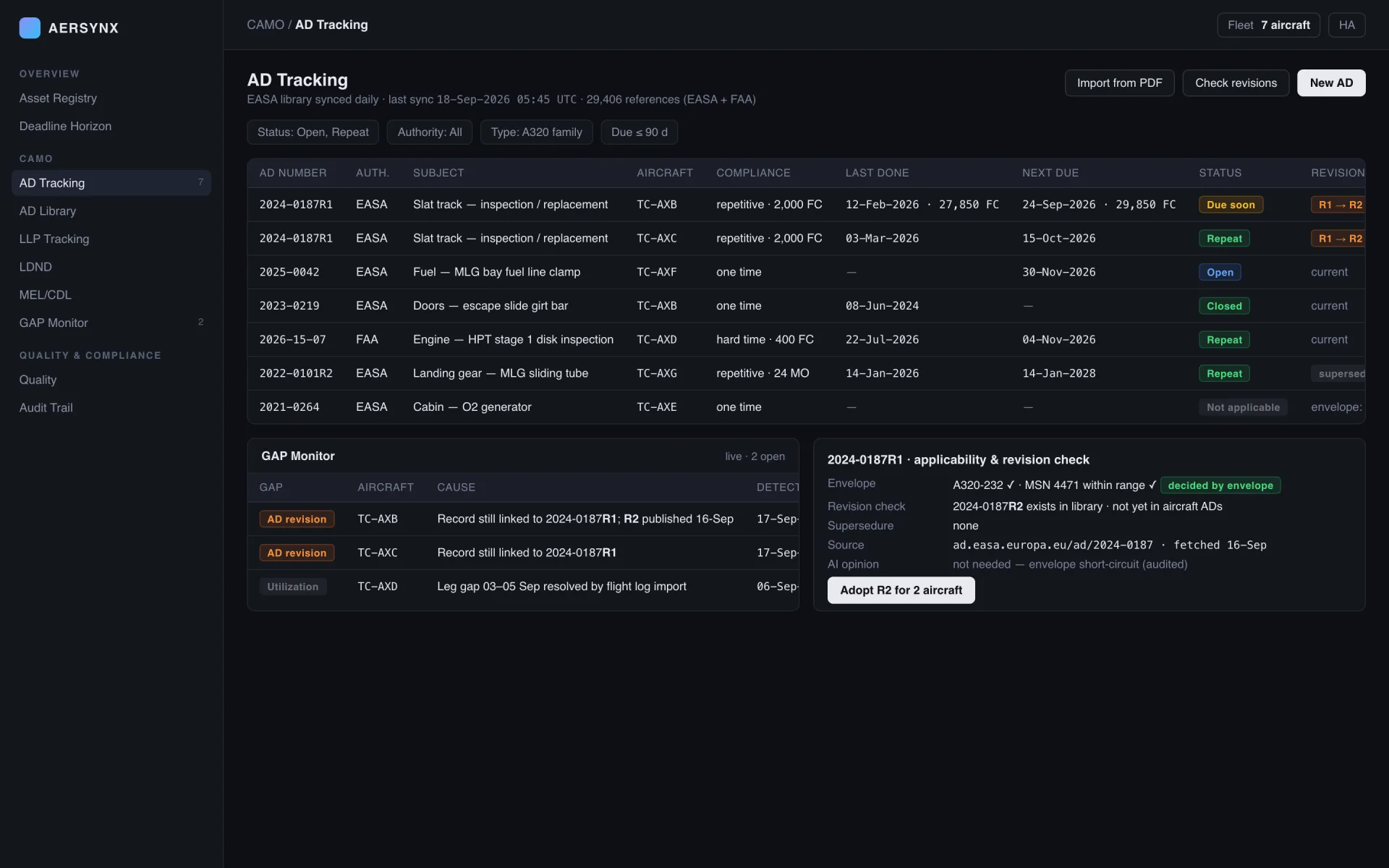
AD tracking with Part-21 21.A.3A applicability envelope, LDND/MPD management, AMP programme oversight, and ARC review readiness across the fleet.
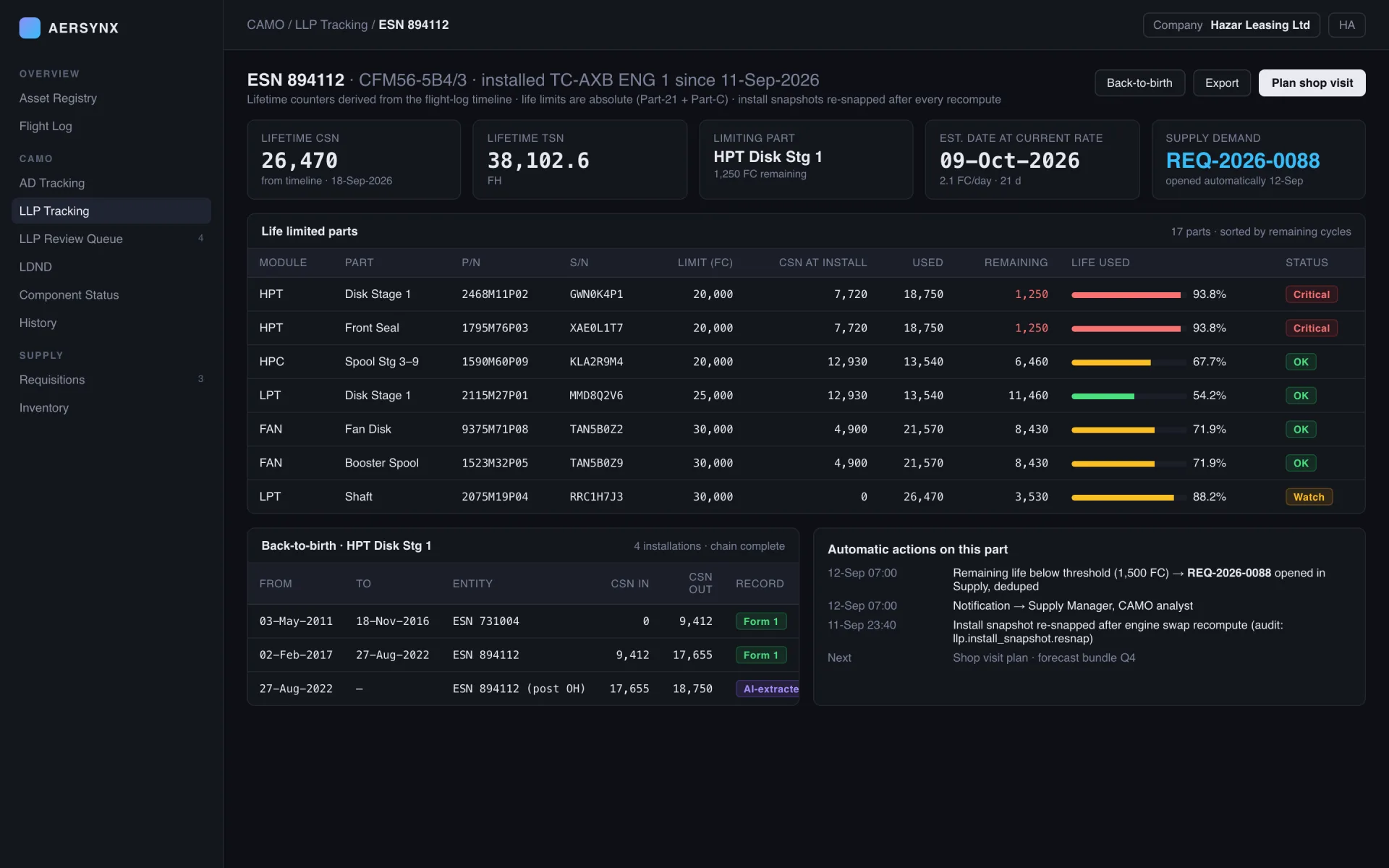
Life-limited parts, hard-time components, on-condition monitoring, avionics and software inventory — with install/remove history and accurate remaining life.
Lease agreements, maintenance reserves with auto-recalculating redelivery conditions, and transition project tracking for delivery and redelivery.
AI-assisted document classification, AD applicability reasoning, forecast narratives, anomaly detection, and semantic records search across every module.
Every due item from every module — airworthiness directives, LLPs, hard-time components, LDND tasks, deferrals, certificates, and lease milestones — aggregated into a single per-aircraft timeline.
See how it works →A single timeline per aircraft — sourced from airworthiness directives, life-limited parts, hard-time components, LDND tasks, MEL/CDL items, certificates, and lease events. Severity is computed from days-to-due, not from which module raised the signal.
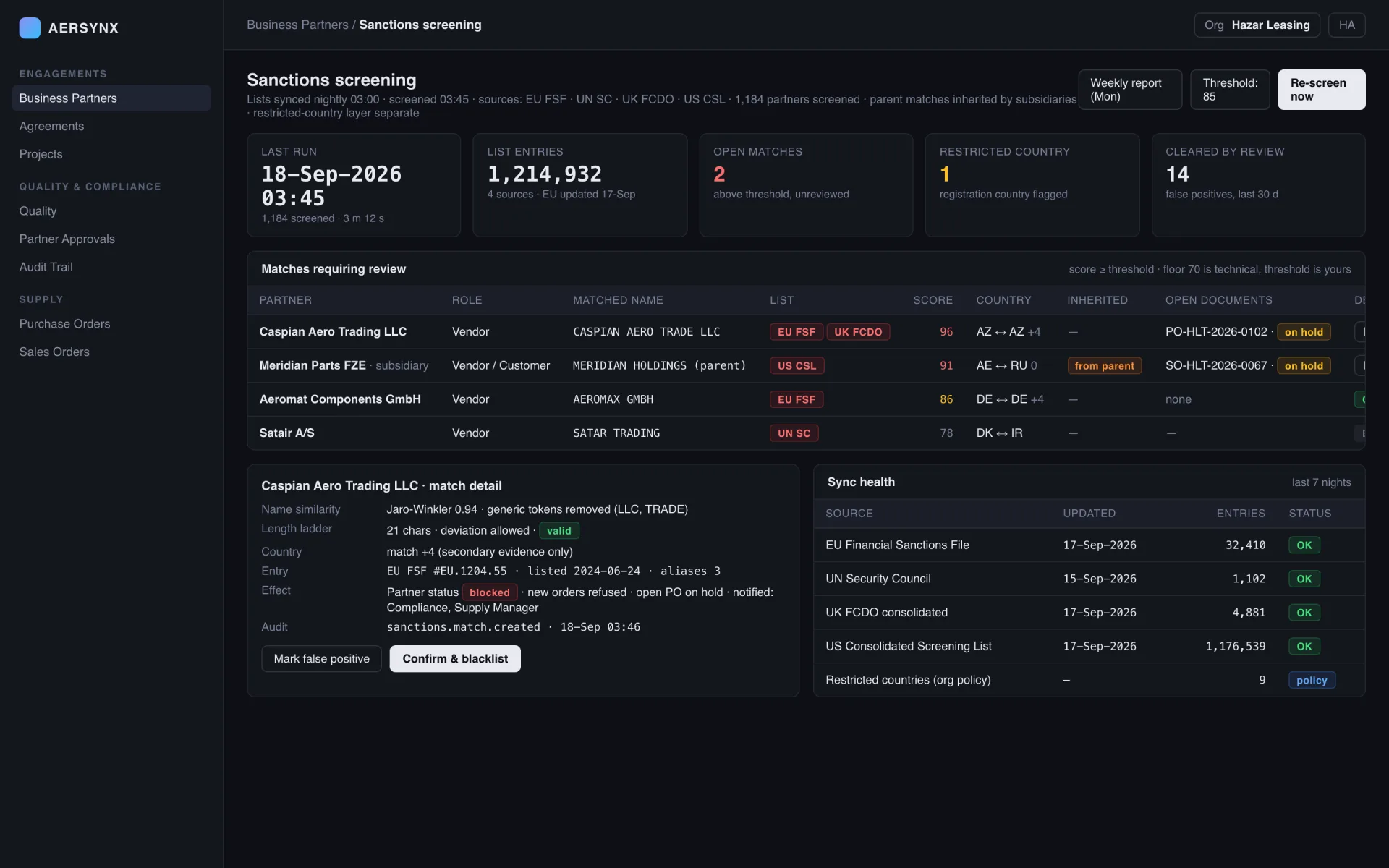
Every compliance discipline modelled with its own rules and rhythms — then unified through shared aircraft identity, organisation isolation, and auditable change history.
Aersynx clusters compliance events that fall within a configurable time window and proposes a consolidated shop visit plan. One click turns a suggestion into a materialised plan — with items, dates, and ground time.
A shop visit report is simultaneously a records document, an AD compliance artefact, and a component event. Aersynx bridges documents across modules without losing the airworthiness audit trail.
A technical record lands in the Records module — whether as a scanned PDF, a native digital file, or a structured upload from a shop visit.
The document is classified by type and candidate target module. A deterministic heuristic takes over whenever AI confidence is low, so no record is left unclassified.
High-confidence cross-module suggestions queue into a dedicated review inbox. A CAMO engineer inspects the AI rationale, the source rationale, and any applicable context.
On approval, the record is bridged to its target module with a signed event capturing IP, user agent, target context, and rationale — the airworthiness audit trail stays intact.
Purpose-built AI capabilities with deterministic fallbacks — every feature is designed for the specific challenges of continuing airworthiness.
Uploaded records are automatically classified by type — shop visit reports, Form 1 / 8130-3, AD compliance records, work orders — with a deterministic fallback when AI confidence is low.
Part-21 21.A.3A envelope short-circuits before AI. The envelope rules out applicability based on effective date versus the aircraft baseline; AI explains the remainder.
Executive-ready summaries of upcoming maintenance. Fleet health, critical items, and recommended actions — generated in professional aviation language.
Utilization data sanity — regression, suspicious gaps, unrealistic growth — surfaced automatically. Findings land in a central gap monitor for operator review.
AI-assisted ranking on top of full-text search. Natural language queries across every record, with per-aircraft and per-document-type scoping.
Due items clustered by time proximity into candidate shop visit plans. One click turns a suggestion into a materialized plan with items, dates, and ground time.
Four stages, one controlled pipeline — records and compliance flow together without hand-offs, spreadsheets, or lost context.
Records and utilization data flow in — from scans, exports, spreadsheets, or direct upload. OCR and schema validation normalise everything to the platform model.
AI identifies document type, target module, and cross-references. Deterministic fallbacks guarantee every record lands in the right queue, even at low confidence.
CAMO and records engineers review findings, approve cross-module bridges, and sign compliance events — every action tracked in an append-only audit trail.
Deadlines, certificates, and component status update in real time. Forecasts, bundle suggestions, and readiness scores reflect the current fleet state, not a stale snapshot.
Continuing airworthiness demands traceability. The platform is structured so that every compliance decision survives an audit, not just a demo.
Part-21 21.A.3A AD applicability envelope. Part-C continuing airworthiness logic. Inspector review workflow mapped to regulatory expectations for technical records and ARC readiness.
Organisation-level data isolation at the database layer. Row-level policies enforce boundaries on every query. Role-aware access across every module — no shared state between tenants, ever.
Systematic validation at every API boundary. Authority-gated write paths for aircraft master data. Comprehensive regression coverage with deterministic fallbacks for every AI touchpoint.
Share your fleet profile and priorities — we'll set up a walkthrough against a real-world scenario you care about.
info@aersynx.com