Aersynx
By role

One fleet. Five jobs. Five different things that keep you up at night.

A lessor fears a redelivery dispute. A CAMO fears a finding. An asset manager fears a surprise shop visit. They all read the same aircraft record — but each needs the part that protects them. Here is how Aersynx looks from each seat.

Aircraft Lessors

The remaining life you quote is the value you can defend.

Asset value erodes quietly between leases. When the records are thin at redelivery, you negotiate from the weak side — and a disputed back-to-birth chain or an unreconciled maintenance reserve can wipe out the margin on the whole transaction.

Redelivery in 90 days, and the operator's back-to-birth file is missing two Form 1s — every day of hunting is a day you're not negotiating the reserves drawdown.

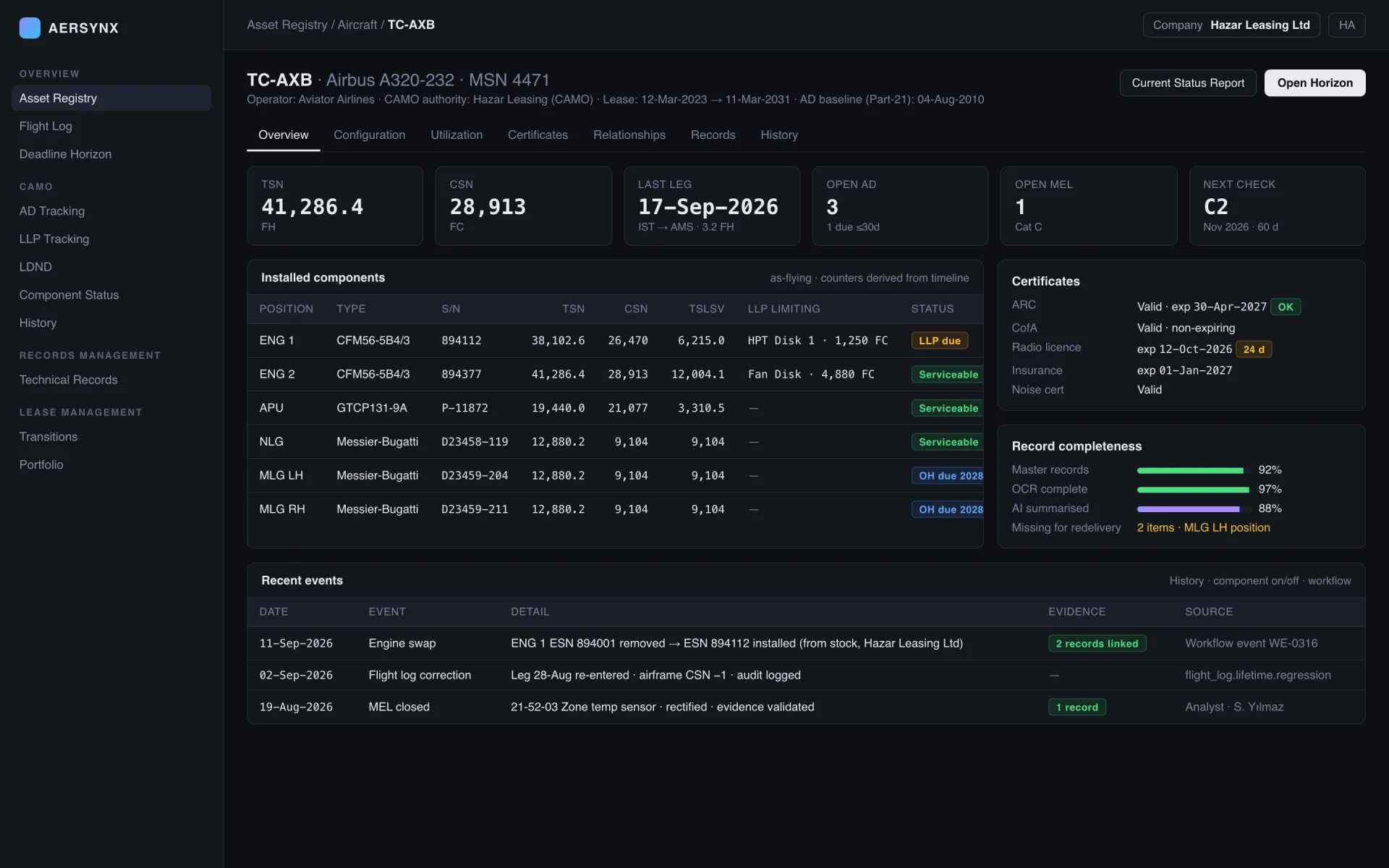
  • Provable remaining life backed by the back-to-birth chain, not a spreadsheet that an overhaul silently reset.
  • Redelivery conditions and their evidence kept complete and audit-ready against the asset.
  • Maintenance reserves on an append-only ledger that reconciles to the same record.
  • Portfolio concentration and value exposure visible across the whole fleet, by type.
How a lessor works it
  1. 01Import the back-to-birth chain so remaining life rests on the records, not a spreadsheet.
  2. 02Keep redelivery conditions and their evidence live against the asset through the lease.
  3. 03Export the evidence package a buyer's technical team can verify, with reserves reconciled to the same record.
aersynx / portfolio · risk
Reserves balance$4.2Mledger reconciled
Redelivery in 90d3conditions tracked
Records completeness112 / 118before handover
Top type exposureA320neo38% of fleet
aersynx / deadline-horizon
Live
TC-AHZ
AD 2024-18-07 · Repetitive
Overdue
TC-AHZ
MEL Cat B · Deferral
Approaching
D-AXLR
LLP — Stage 2 disk
Approaching
D-AXLR
ARC review · M.A.901
On track
9H-MNT
C-Check · LDND task
On track
OverdueApproachingOn track
CAMO Organizations

Every aircraft airworthy, every finding answered before it's written.

Your exposure is a missed deadline you didn't see coming. A repetitive AD silently reverts to repeat and slips past its next interval; an ARC gets issued without M.A.901 readiness. Either one is a finding — or a grounded tail.

An auditor opens an AMP task at random and asks for the basis — and the linked work card, the LDND history, and the sign-off are already attached, not somewhere on a shared drive.

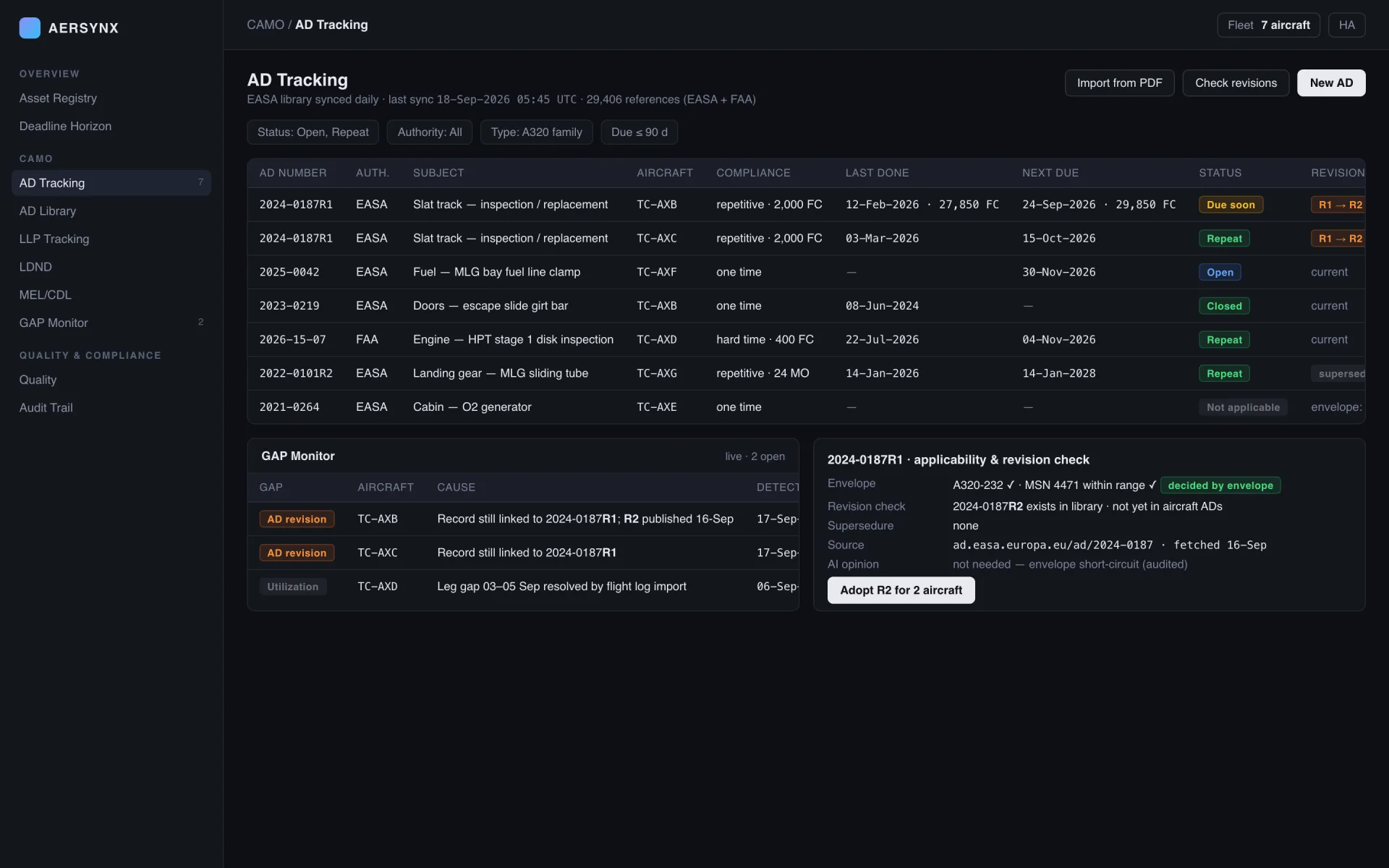
  • AD, AMP, LDND, and MEL/CDL in one compliance layer — repetitive ADs return to repeat, not open.
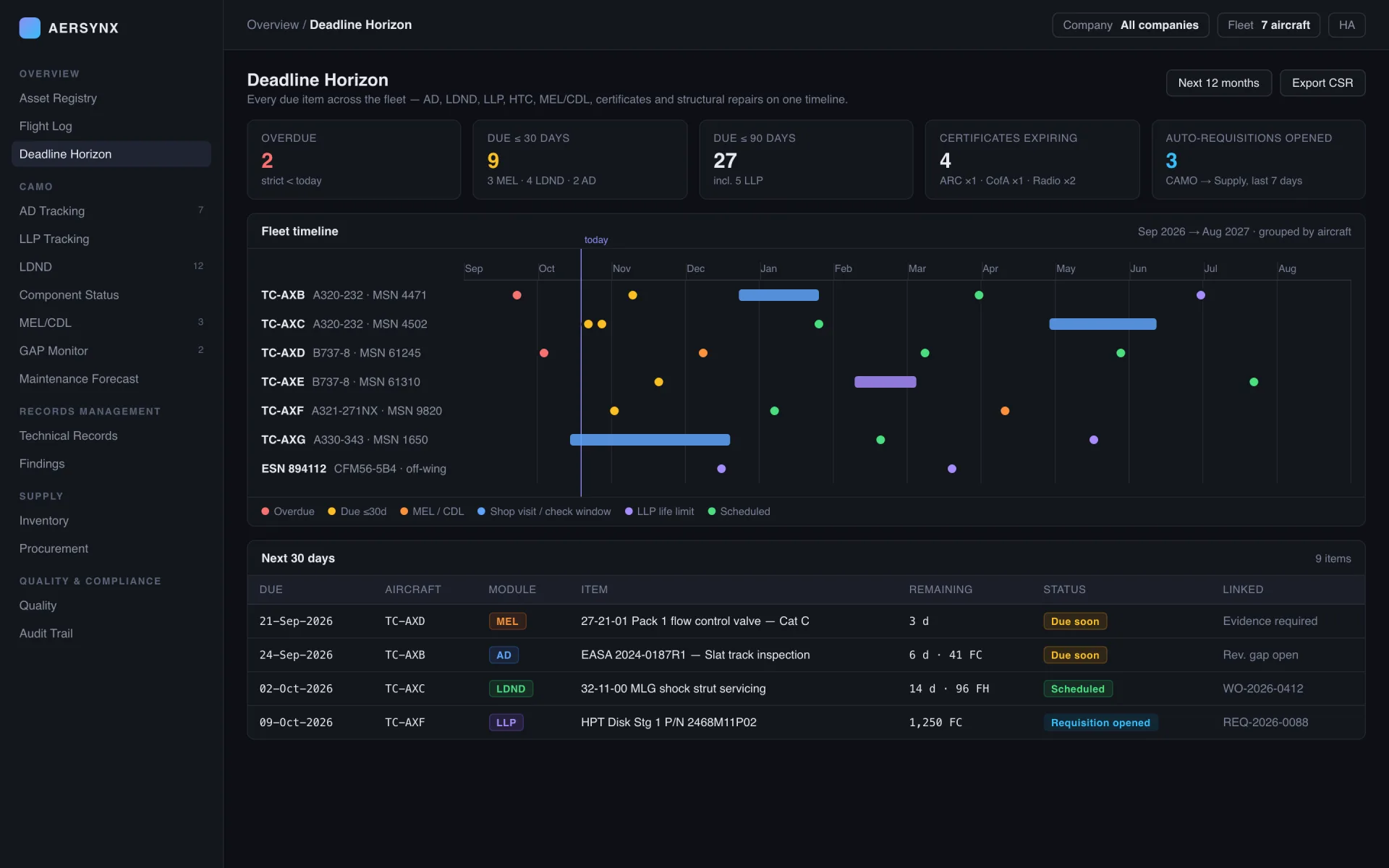
  • Deadline Horizon collapses 7+ sources into one ranked timeline so the date that matters surfaces first.
  • ARC issuance gated on M.A.901 readiness — no certificate without the evidence behind it.
  • Draft-to-commit: AI reads the binder, but a CAMO analyst signs every master record.
How a CAMO works it
  1. 01Fetch and scope ADs to the affected tails, with applicability resolved against the configuration.
  2. 02Deadline Horizon ranks every interval so the date that grounds a tail surfaces first.
  3. 03The analyst commits compliance with the work card and LDND history already attached as evidence.
Asset Managers

Plan the fleet months out — not the panic the morning of.

A shop visit you didn't forecast collides with a slot you can't get, and a reliability trend that was creeping for months only shows up as an IFSD. Surprises are the expensive part of this job.

The forecast bundles two engines into one shop visit because their LLP limits land in the same window — one downtime instead of two, spotted a quarter ahead.

  • Forecast with shop-visit bundling so converging limits become one downtime, not two.
  • Reliability — dispatch reliability, rate per 1,000 FH, IFSD, and repetitive-defect detection from the canonical model.
  • LLP remaining life on absolute Part-21 / Part-C limits, never reset by an overhaul.
  • One picture of near-term capacity demand and long-term fleet trend.
How an asset manager works it
  1. 01Forecast the limit windows so converging shop visits show up a quarter out, not the morning of.
  2. 02Bundle the visits that land in the same window into one downtime instead of two.
  3. 03Watch reliability for the repetitive defect before it surfaces as an IFSD.
aersynx / llp-tracking
ESN 716341 · Stage 1 Disk0% rem
ESN 716341 · HPT Disk0% rem
APU 3201 · Wheel0% rem
MLG · Shock Strut0% rem
aersynx / transition · checklist
Records checklist112 / 118 complete
Ready
Asset comparisontitle vs replacement reconciled
Ready
IATA binderexport pending 6 records
In progress
Transition Teams

Close the handover with the records complete and the history intact.

At delivery and redelivery, the history is what walks out the door. A records gap found on the ramp turns into a lease dispute; a title part confused with its replacement turns into weeks of reconciliation no one budgeted for.

The checklist blocks export until the last six records clear — so the IATA binder that leaves with the aircraft is whole, not 94% done.

  • A records checklist that blocks the package on gaps instead of discovering them later.
  • Asset Comparison reconciles the title part against its replacement, position by position.
  • IATA-format binders exported from the same verified records, not assembled by hand.
  • Full provenance kept — the defensible history travels with the aircraft.
How a transition team works it
  1. 01Redelivery conditions become a checklist tracked against the asset, item by item.
  2. 02Build the IATA binder as the records clear, not in a scramble the week before delivery.
  3. 03The master-record gate blocks export until every position is reconciled — no gap walks out the door.
MRO / Supply Teams

The part on the shelf and the part on the aircraft are one record.

Early access — in active hardening

Most supply systems are a separate world you reconcile against your technical records by hand. That gap is where a stock-unit gets reserved twice into an AOG, and where a certificate chain breaks into a Part-145 exposure — both hidden in a spreadsheet until it's too late.

A hard reservation binds a specific stock-unit to one job, so the same part can't be sold out from under an AOG — and its Form 1 chain stays linked to the records the rest of the fleet runs on.

  • One part master shared with compliance and records — stock-unit, condition, and Form 1 chain on the same truth.
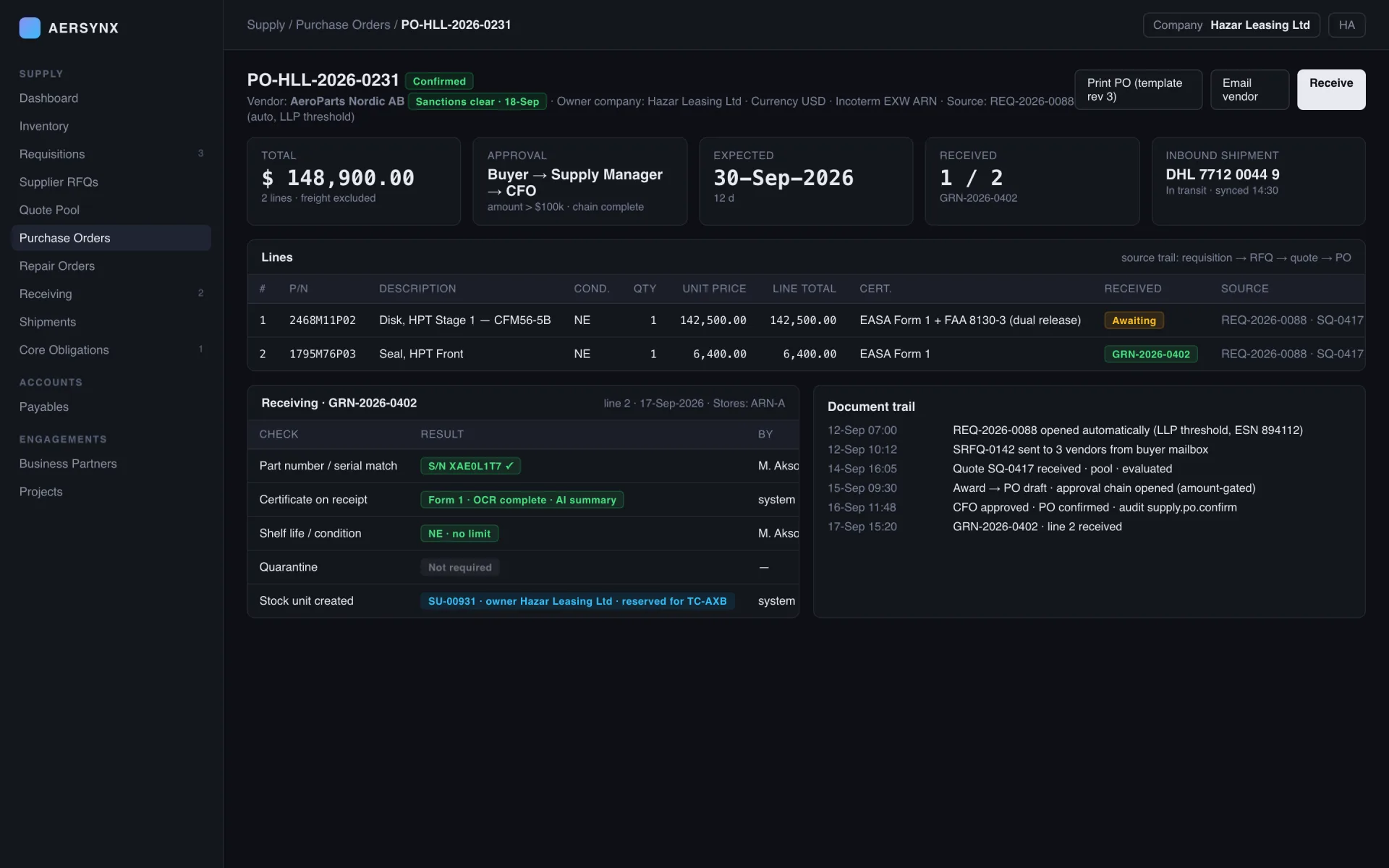
  • Procurement from RFQ and quotation through purchase order, GRN, and a three-way match (PO ↔ GRN ↔ invoice).
  • Hard reservation that binds a real unit — designed against oversell, not hoping against it.
  • Send-to-repair tracking on an append-only, multi-currency ledger — corrected, never deleted.
How a supply desk works itEarly access
  1. 01Receive a unit against its GRN, matched to the PO it came in on.
  2. 02Hard-reserve the specific stock-unit to one job so it can't be sold out from under an AOG.
  3. 03Keep the Form 1 certificate chain linked from the shelf to the aircraft it's installed on.
Related playbookSee the Supply module

Supply is in early access and active hardening. The integration thesis is real and demoable today; we'd rather build it with a few design partners than oversell it.

Explore Supply
aersynx / records · semantic search
last shop visit form 1 for ESN 716341 AI rerank
EASA Form 1 — Engine Shop Visit Verified

Authorized release, ESN 716341, 12-Mar-2026 · matched on meaning, not keywords

Delivery Report — Borescope Verified

Inspection findings summarized by AI · analyst-reviewed

Find your seat in the record.

Tell us the job you're trying to protect — we'll run it through Aersynx with your fleet.