What counts as evidence
A scanned document attached to a record is not evidence until somebody can say what it shows, where it came from, and which aircraft it belongs to.
A file attached to a record is not evidence until someone can say what it shows.
Most maintenance systems let you attach a file to anything. That is presented as flexibility, and for a while it is. The bill arrives during a records review, when somebody opens an attachment named scan_047.pdf and nobody in the room can say what it was meant to prove.
#Attachment is not evidence
An attachment answers one question: is there a file. Evidence has to answer four, and a records reviewer will ask all four:
- What does the document say — not what is the filename, what is in it
- Which event produced it — a shop visit, an inspection, a transition
- Which aircraft, engine or component it belongs to
- Whether anyone has read it since it was uploaded
A system can enforce all four, or it can leave them to habit. Habit works until the person who had the habit leaves.
#The four conditions, enforced
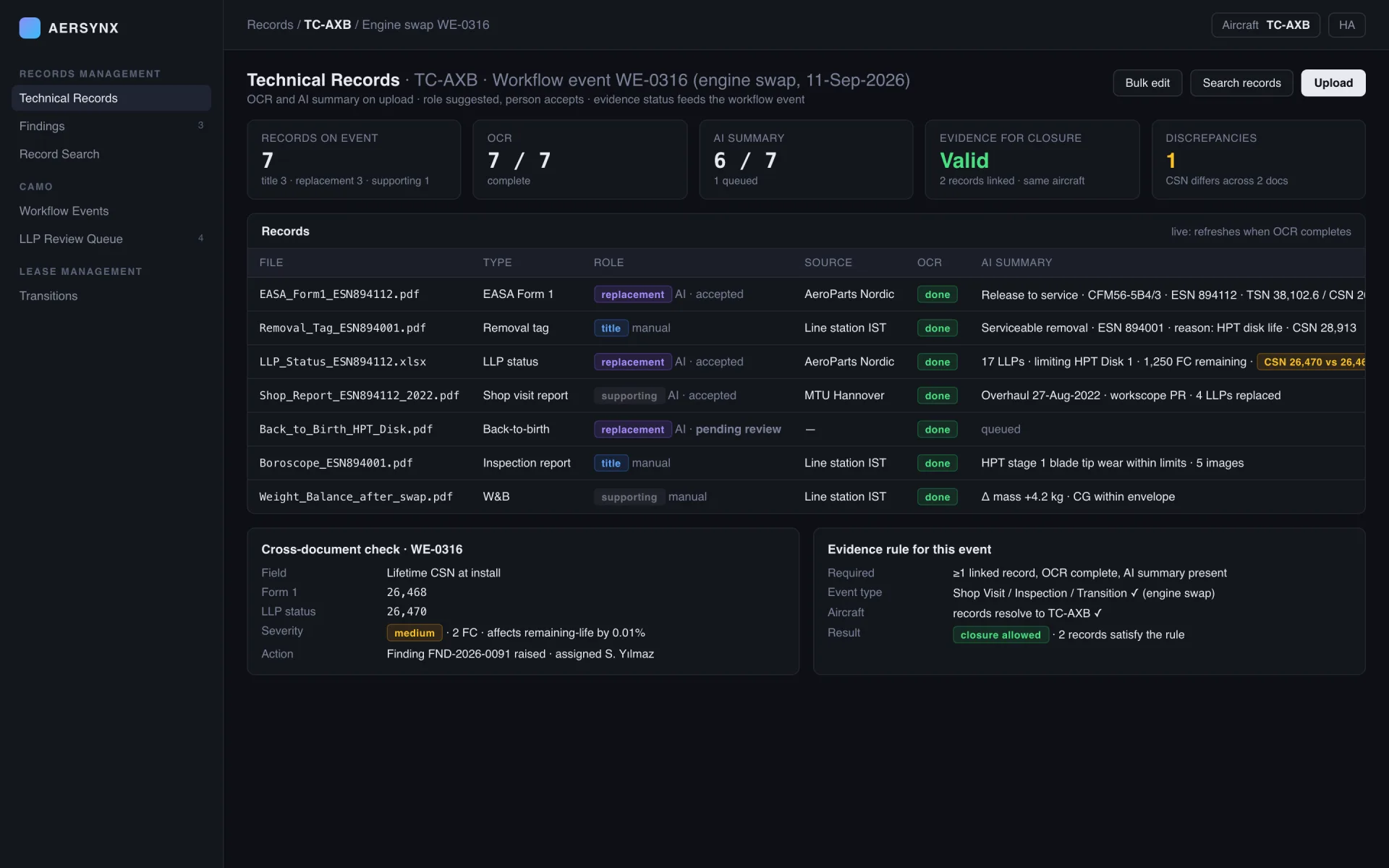
In AerSynx, closing certain critical items requires linked records, and the link is checked rather than assumed. A record qualifies only if its text has actually been extracted, only if a summary of it exists, only if it is attached to an event of a type the module accepts, and only if that event resolves to the same aircraft as the item being closed.
If any one of those fails, the close is refused with a reason that names the failure — the document was never read, the summary is missing, the event type is wrong for this module, the aircraft does not match. Not a generic validation error. The specific condition that was not met.
#Why the allowlist is narrow, and different per module
The event types accepted as evidence are not the same everywhere, and the difference is deliberate. A component overhaul can be evidenced by a shop visit, an inspection or a transition. A deferred defect rectification can be evidenced by a shop visit or an inspection — but not by a transition, because an aircraft changing hands does not rectify anything.
A rule that is the same everywhere is usually a rule nobody thought about twice.
#The part people argue with
The condition that draws the most objection is the requirement that the document has been read by the system at all — that its text was extracted and summarised before it can close anything. It feels like a bureaucratic gate on a busy day.
It is the condition that pays. A document nobody can search is a document that will not be found during the review that needs it, and a record that cannot be found may as well not exist. The gate is not there to slow down the person attaching the file. It is there for the person who opens it five years later, who will not be the same person.
#What this does not do
It does not judge whether the document is correct. No system can. It establishes that the document is readable, attributed, and attached to the right aircraft — which is the part a system can guarantee and a person reliably cannot.