Demand arrives on its own
Life limits in CAMO open requisitions here without duplicates; the buyer starts from a list, not from an email.
Aviation supply chain management software: inventory, quotation, sales, procurement, logistics and tooling on one part master, owned company by company. A life limit in CAMO opens the demand here automatically.
For the buyer, the stores keeper, the trader and the logistics coordinator who share one stock and one partner list.

Life limits in CAMO open requisitions here without duplicates; the buyer starts from a list, not from an email.
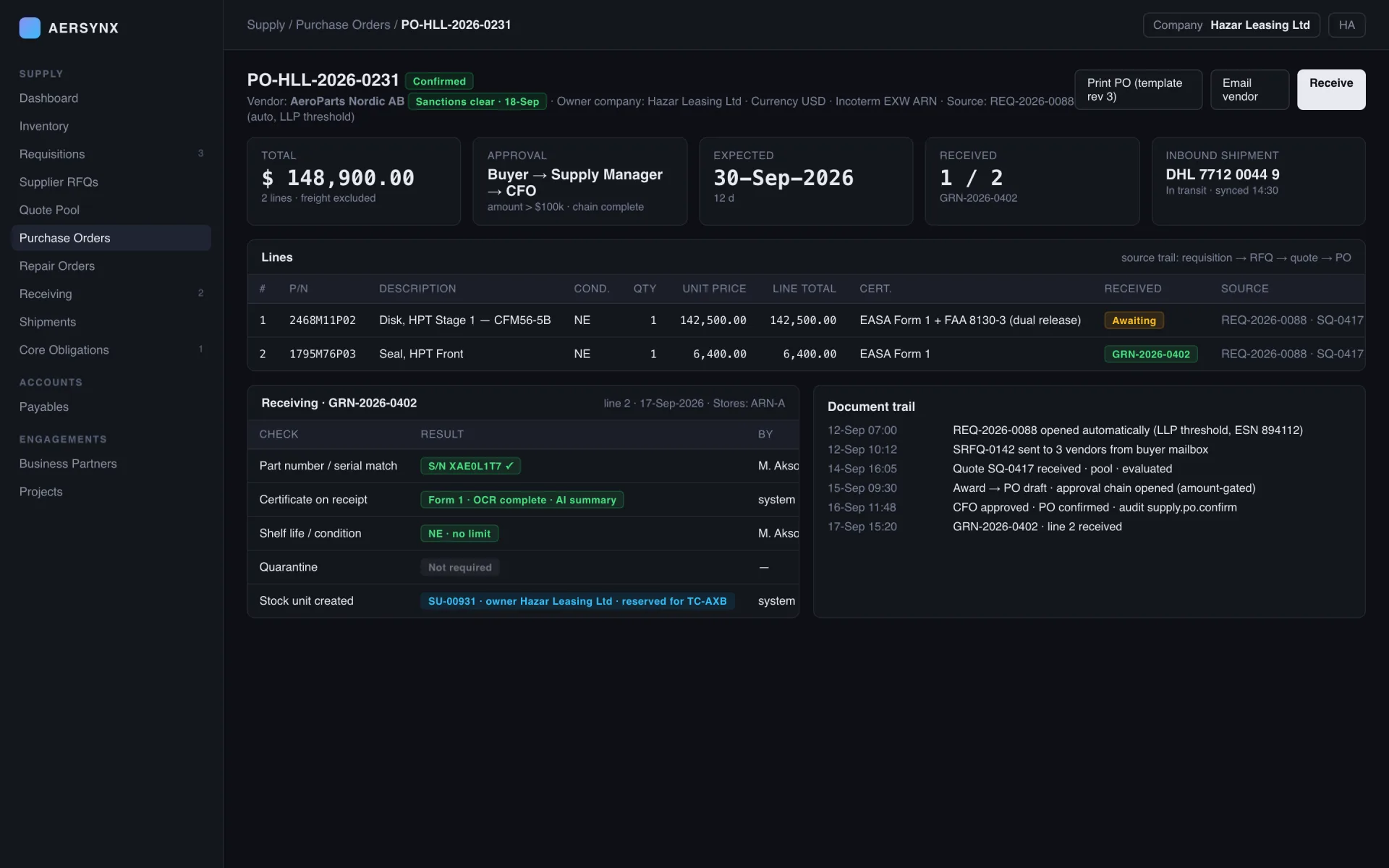
Supplier RFQs go out from the buyer's own mailbox, quotes land in a pool, the award becomes the PO, receiving checks the certificate, the stock unit is born owned by a company.
Exchange cores are tracked as obligations with due dates and penalties; tools carry calibration state; every partner is screened nightly against four lists.
Every stage is a record that points at the one before it. Nothing is re-keyed.
LLP HPT Disk 1 · 1,250 FC leftthreshold crossed on ESN 894112REQ-2026-0088opened by a life limit, dedupedSRFQ-0142 · 3 vendorssent from the buyer's mailboxSQ-0417 · $142,500evaluated side by sidePO-HLL-2026-0231chain: buyer → manager → CFOGRN-2026-0402 · Form 1 ✓certificate checked on receiptSU-00931 · owner Hazar Leasing Ltdreserved for TC-AXBSerial and batch traceability, certificates on receipt, quarantine, stock movements, requisitions, replenishment suggestions and intercompany transfers, on one part master shared by the whole organisation. Every stock unit is owned by a company, never by the tenant as a whole, so 'whose asset is it' is answered on the unit itself.
Supplier RFQs sent from the buyer's own mailbox, a quote pool where answers land, evaluations, purchase orders and repair orders with an approval chain by amount that walks the title hierarchy. The award becomes the PO; the PO becomes the receiving expectation.
| Module | Primary job | Signals |
|---|---|---|
| Inventory | Company-owned stock, traceability | serial & batchcompany-owned units |
| Sales & Quotation | RFQ to sales order | AI email intake, reviewedexplicit grant to quote |
| Procurement | Supplier RFQ to purchase order | buyer's own mailboxquote pool |
| Logistics | Shipments, customs, RMA | hourly carrier synccustoms & RMA |
| Core Obligations | Exchange and loan core control | due from partner termspenalty on overdue |
| Vendor Billing and Payables | Vendor invoices and payments | tied to the ordercredit & debit notes |
| Tools | Tool catalogue and calibration | tool ≠ partcalibration inherited |
Serial and batch traceability, certificates on receipt, quarantine, stock movements, requisitions, replenishment suggestions and intercompany transfers, on one part master shared by the whole organisation. Every stock unit is owned by a company, never by the tenant as a whole, so 'whose asset is it' is answered on the unit itself.
Customer RFQs, including intake from plain email structured by AI and written only after a person reviews it, quotations, sales orders and invoices. Sending a quotation commits a price to the outside world and therefore requires an explicit grant, not just an amount limit.
Supplier RFQs sent from the buyer's own mailbox, a quote pool where answers land, evaluations, purchase orders and repair orders with an approval chain by amount that walks the title hierarchy. The award becomes the PO; the PO becomes the receiving expectation.
Handoffs, picking, inbound and outbound shipments with carrier tracking synced every hour, customs entries and RMA. A delivered exchange shipment opens the customer's core obligation on its own.
Exchange and loan cores tracked as obligations with a due date from the partner's own return terms, aging buckets, penalties when overdue and automatic credit notes when the core comes back. One engine serves the buying and the selling side; only the direction differs.
Vendor invoices, credit and debit notes, returns, payments, balances and due-date tracking, tied to the order that created the obligation. The money side of a purchase is a record, not a spreadsheet next to it.
A tool is not a part: it has its own catalogue, physical items with a permanent tag, calibration and inspection state inherited from the definition, loans with due dates and a daily report. A tool out of calibration cannot be signed onto a job; tools enter the system only through an order, like everything else.
The questions this workspace gets asked most often.
Inventory, quotation, sales, procurement, logistics, core obligations, payables and tooling — on one part master shared across the organisation. The parts catalogue and the partner list are common; the orders, agreements and the stock itself are owned company by company, because the question of whose money bought the part has one answer.
It arrives as demand on its own. When CAMO sweeps a life limit or a hard-time threshold, the requirement opens as a requisition in Supply with the aircraft and the limit attached. From there the chain runs RFQ to quotation to order to receipt to invoice without re-keying the part number at any step.
By amount and by title. Each action a person can take is named individually, and orders above a title's approval limit walk an approval chain up the hierarchy rather than being blocked outright — a junior buyer can start the order that a manager confirms. Authority is managed on one screen, not per module.
Yes, and that is the point of the company axis. Part master data and business partners are shared across the organisation, while orders, agreements, invoices and stock carry the company that owns them. A user sees only the companies they have access to, and a partial total is reported as partial rather than presented as complete.
Bring a real requisition. We take it through RFQ, quote pool, purchase order and receiving on your own part master and show the document trail at the end.