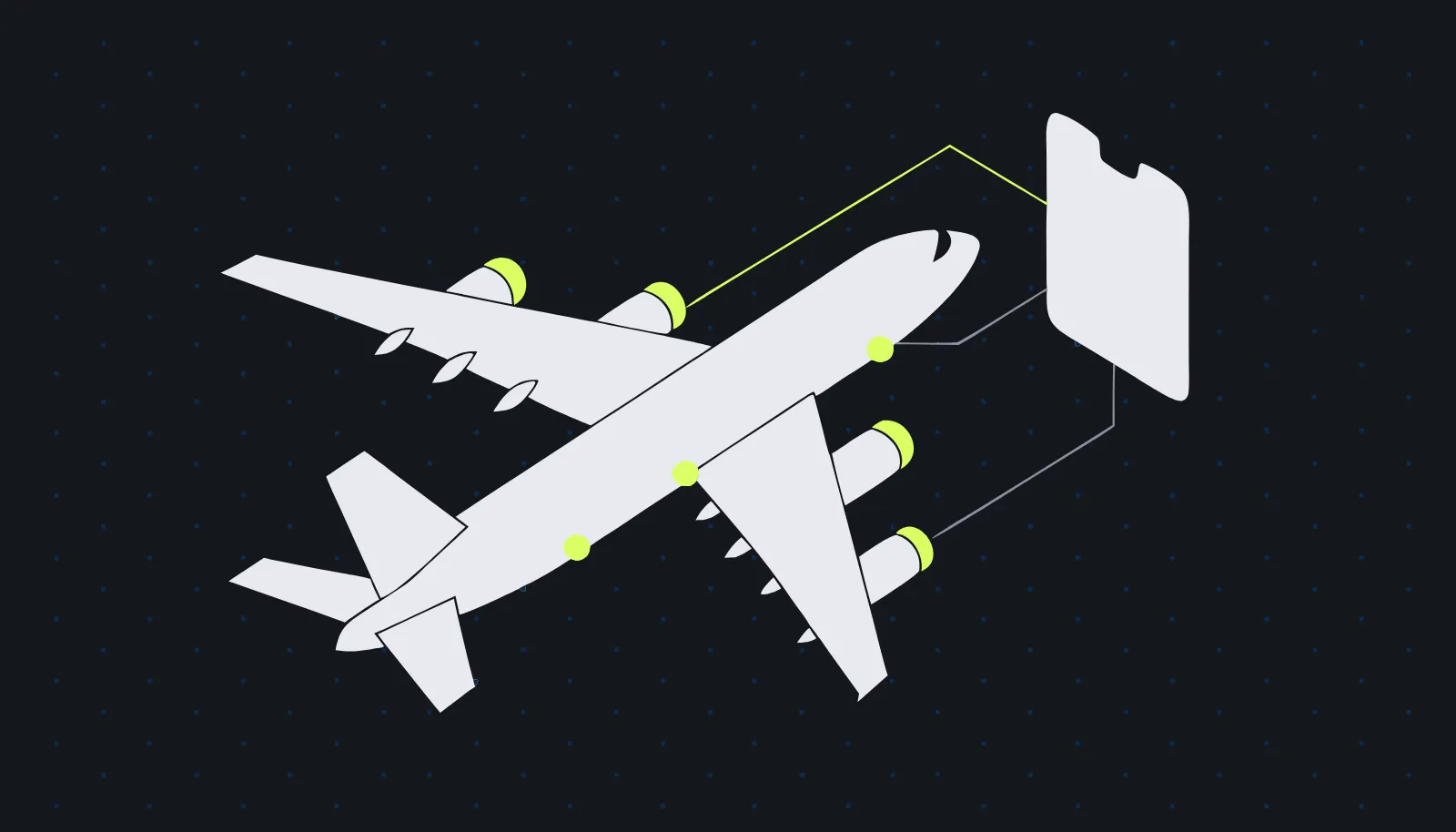
One counter, everywhere
TSN, CSN and component lifetimes are derived from the flight timeline and read by every other workspace. Nobody types a counter twice.
The registry every other workspace reads from: aircraft, engines, APUs and landing gears with their counters derived from the flight timeline, and one horizon for everything that falls due.
For the engineer who needs one number to be right everywhere, and the manager who needs one screen for the whole fleet.

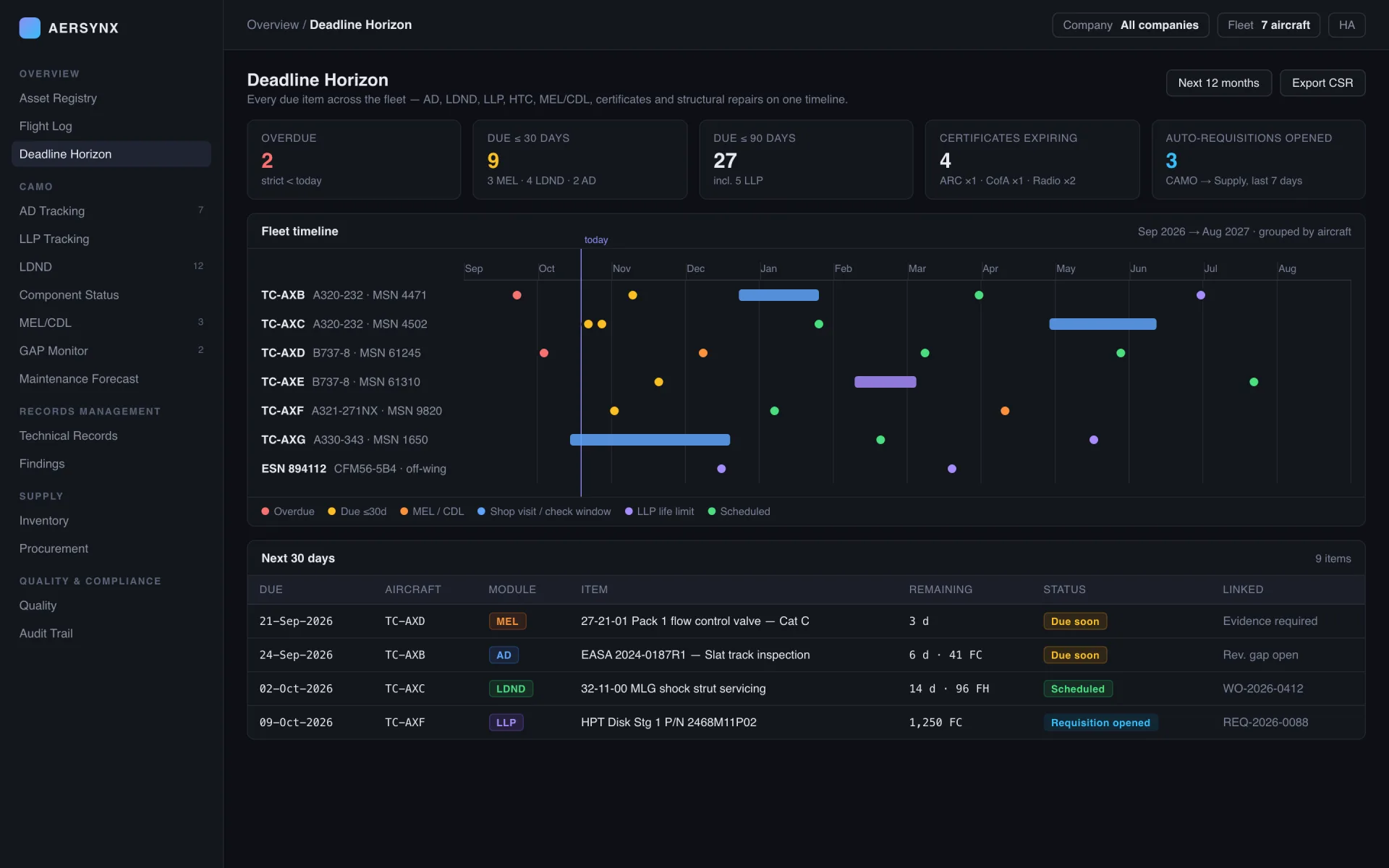
TSN, CSN and component lifetimes are derived from the flight timeline and read by every other workspace. Nobody types a counter twice.
Every directive, task, life limit, MEL item and certificate sits on one horizon. Filter by aircraft, by module or by the next thirty days.
An engine that comes off one aircraft and goes onto another keeps its row, its history and its life. Nothing is archived and re-created.
Select an aircraft, and the registry, the counters and the horizon are the same record seen three ways.
TC-AXB · A320-232 · MSN 4471registry card with certificates and CAMO relationshipENG 1 ESN 894112 · ENG 2 ESN 894377 · APU · NLG · MLG ×2physical parts on positions, moved not re-createdTSN 41,286.4 · CSN 28,913derived from the flight timeline after every leg2 overdue · 9 due ≤ 30 d · 27 due ≤ 90 dAD, LDND, LLP, HTC, MEL, certificates on one lineAircraft, engines, APUs and landing gears as master records, with certificates, registrations, CAMO relationships, data shares and cabin configuration on the same card. A component row is a physical part, not an installation: when an engine comes off one aircraft and goes onto another, the same row moves with its history and its life. Nothing is archived and re-created, so the serial number stays unique and the back-to-birth chain stays whole.
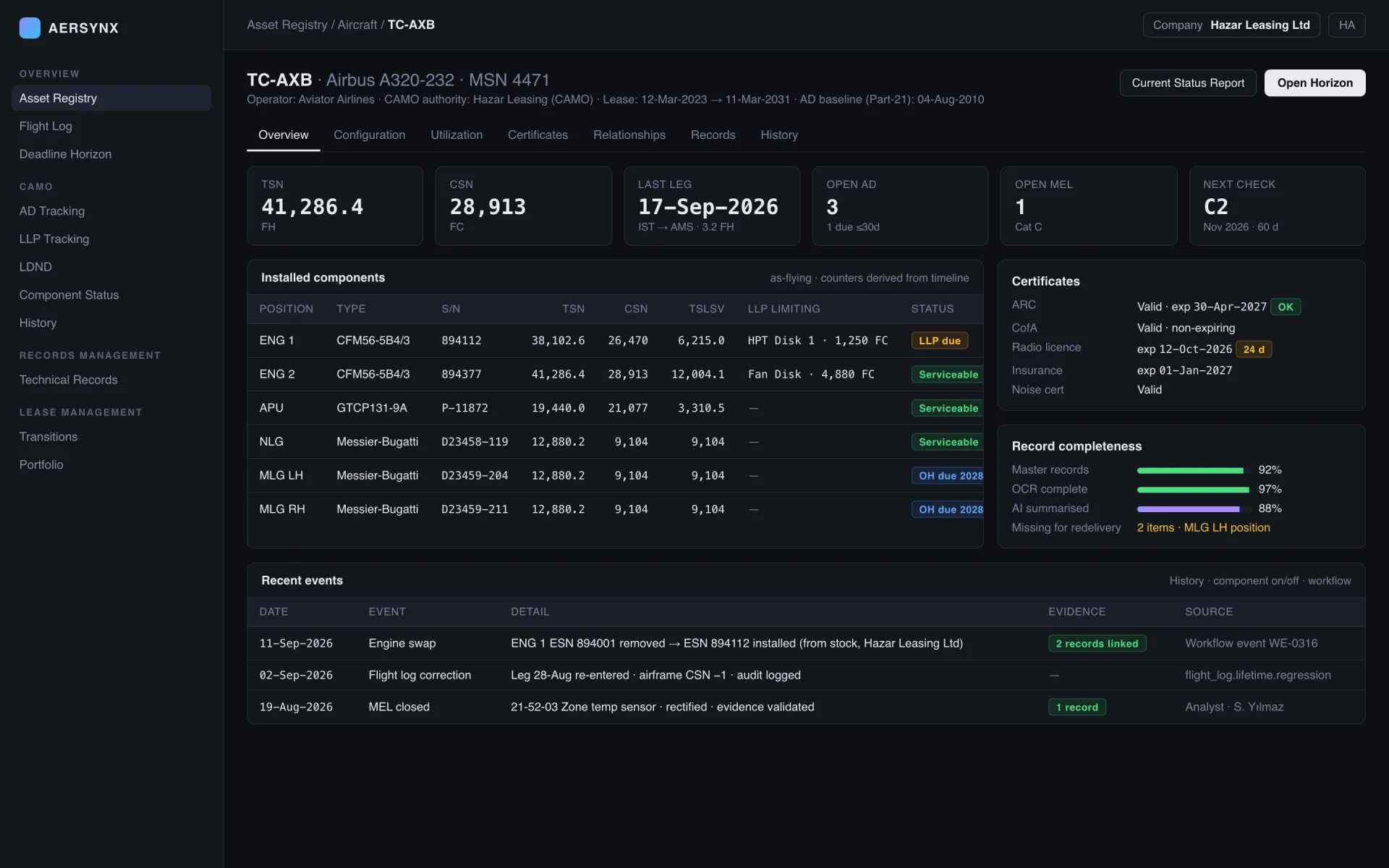
AD, LDND, LLP, HTC, MEL/CDL, certificates and structural repairs on one fleet-wide timeline, grouped by aircraft, filtered by module or by the next thirty days. Overdue is strictly before today; an item due today is due today. The horizon is also where an automatic requisition opened by a life limit first becomes visible.
| Module | Primary job | Signals |
|---|---|---|
| Asset Registry | Master records for aircraft and components | physical part, not installationcertificates & registrations |
| Flight Log | Leg-level utilisation, counters recomputed | recompute from truthbackdated legs allowed |
| Asset Management | Fleet lifecycle overview | fleet-level viewper-viewer entitlement |
| Deadline Horizon | Every due item on one timeline | 7 modules, one timelineoverdue is strictly < today |
Aircraft, engines, APUs and landing gears as master records, with certificates, registrations, CAMO relationships, data shares and cabin configuration on the same card. A component row is a physical part, not an installation: when an engine comes off one aircraft and goes onto another, the same row moves with its history and its life. Nothing is archived and re-created, so the serial number stays unique and the back-to-birth chain stays whole.
Leg-level utilisation per aircraft, entered by the operator or imported. After every entry the airframe and every installed component are recomputed from the timeline: anchor plus legs, written absolutely. A backdated correction may lower a counter, and that is legitimate; every decrease is written to the audit trail with the reason. LLP install snapshots are re-snapped from the same timeline, so the delta between part and engine never drifts.
Fleet-level overview and lifecycle workflows across owners, operators and CAMOs. Every viewer sees the aircraft they are entitled to, with the technical state pulled from the same record the CAMO maintains, not from a monthly report. Analyses stay private to the organisation that made them, even on a shared aircraft.
AD, LDND, LLP, HTC, MEL/CDL, certificates and structural repairs on one fleet-wide timeline, grouped by aircraft, filtered by module or by the next thirty days. Overdue is strictly before today; an item due today is due today. The horizon is also where an automatic requisition opened by a life limit first becomes visible.
The questions this workspace gets asked most often.
An aircraft is not one asset. Engines, APUs and landing gears each carry their own hours, cycles and limits, and each can move between aircraft. AerSynx keeps a row per physical part rather than per installation, so a component removed from one aircraft and fitted to another keeps its history instead of starting a new one.
They are derived, never typed twice. Counters for the aircraft and every installed component are recomputed from the flight timeline after each leg or checkpoint, so the number a maintenance planner sees is the number the CAMO analyst and the lessor see. A correction to a past leg flows through to every counter that depended on it.
Yes, and it keeps the same record. The part is marked removed and detached from the aircraft rather than archived, so when it is fitted elsewhere the same row moves with its full history and life-limited part data intact. Overhaul does not reset a life limit; only a physically new part starts at zero.
One screen that answers what falls due next across the whole fleet. Directives, life limits, hard-time components, maintenance programme tasks, certificates and deferred defects all report into the same horizon, so the next thing due is never hidden inside a module nobody opened this week.
Bring one tail number with its directives and open tasks. In the first session we build its registry, load its counters and show the horizon it produces.