Directives you did not have to look up
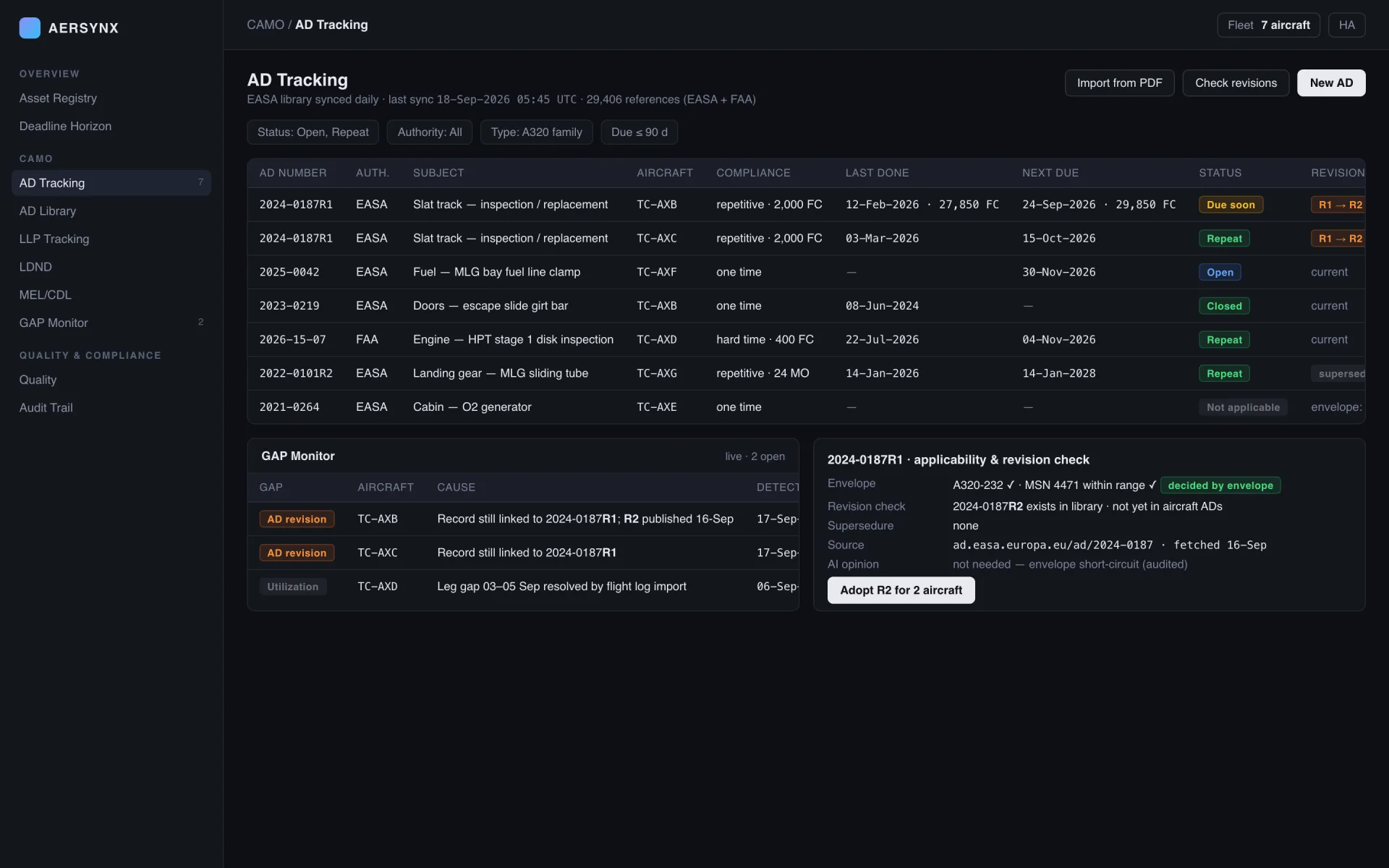
EASA publishes, AerSynx syncs overnight, and the aircraft still linked to the previous revision are on your screen by morning, as gaps.
Directives, life limits, maintenance programmes, deferred defects and review certificates — tracked against the aircraft, not against a spreadsheet tab, and pushed to Supply when a limit approaches.
For the CAMO analyst who signs the compliance statement, and the postholder who answers for it.

EASA publishes, AerSynx syncs overnight, and the aircraft still linked to the previous revision are on your screen by morning, as gaps.
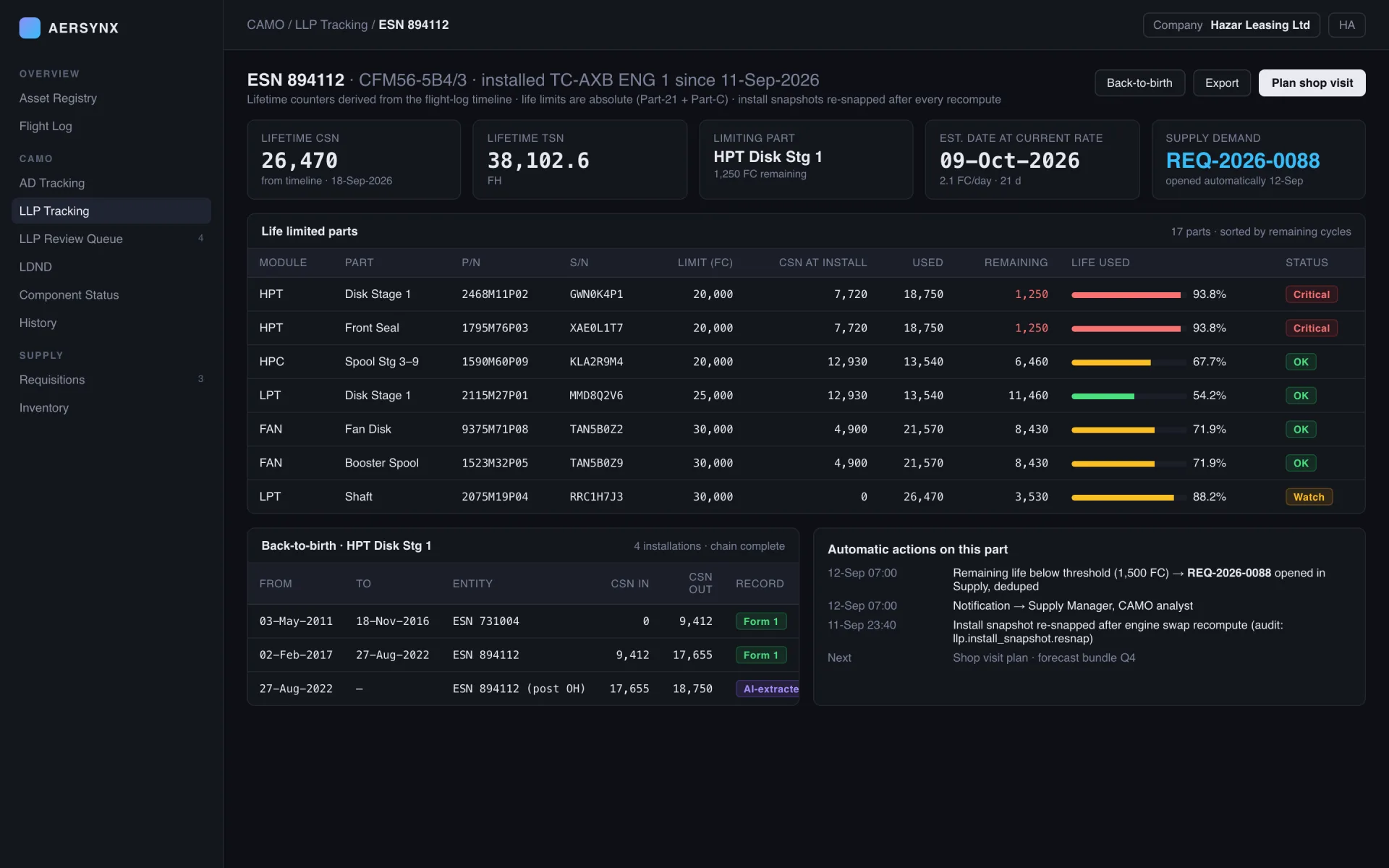
When an LLP or HTC component crosses the threshold, the requisition is already in Supply, deduplicated, with the part and the tail number on it.
A swap, an overhaul or a MEL rectification cannot close without an OCR-complete record attached to the right event and the right aircraft. The server enforces it, not a checklist.
Nobody looks anything up. The library moves, the gap appears, the analyst decides.
2024-0187 R1 → R216-Sep, evening05:45 · 29,406 referenceslibrary updatedenvelope: A320-232 ✓ MSN in range ✓AI only if the envelope cannot decideTC-AXB, TC-AXC still on R105:47 · revision gapFND-2026-0091 · assignedthe analyst escalatesEASA and FAA directives kept as separate records, never merged, each with its authority, source and document. The library holds 29,406 published references and is synced every morning; when a directive is revised or superseded, the aircraft still linked to the previous issue appear as gaps before anyone opens a browser. Applicability is decided by the type and variant envelope first and by AI only when the envelope cannot decide, and every decision is audited.
Life-limited parts against an absolute cycle limit that overhaul, swap and shop visit never reset. One formula computes remaining life for every consumer: the API, the replacement flow, exports, forecast and KPIs. AI-extracted candidates from delivery reports wait in a review queue; only an analyst writes the master record, and the back-to-birth chain is shown installation by installation.
| Module | Primary job | Signals |
|---|---|---|
| AD Tracking and AD Library | Directive compliance and reference library | 29,406 referencesnightly EASA sync |
| LLP Tracking and Review Queue | Remaining-life control | absolute limitone formula everywhere |
| LDND and MPD Management | Recurring task scheduling | utilisation-drivenMPD mapped |
| Component Status | HTC, OCCM and avionics status | HTC · OCCM · avionicsnightly recalculation |
| AMP Management and Gap Analysis | Programme revisions and MPD gaps | revision effectivitygap vs MPD |
| MEL / CDL | Deferred defects with deadlines | category ladderevidence to close |
| Reliability, Forecast and ARC | Trends, forecast and review readiness | monthly periodsalerts on change only |
| Workflow Events, History and Packages | Master record events and handovers | two faces per eventsingle-writer history |
EASA and FAA directives kept as separate records, never merged, each with its authority, source and document. The library holds 29,406 published references and is synced every morning; when a directive is revised or superseded, the aircraft still linked to the previous issue appear as gaps before anyone opens a browser. Applicability is decided by the type and variant envelope first and by AI only when the envelope cannot decide, and every decision is audited.
Life-limited parts against an absolute cycle limit that overhaul, swap and shop visit never reset. One formula computes remaining life for every consumer: the API, the replacement flow, exports, forecast and KPIs. AI-extracted candidates from delivery reports wait in a review queue; only an analyst writes the master record, and the back-to-birth chain is shown installation by installation.
Last done / next due for every recurring task, driven by the aircraft's own utilisation rather than a fixed calendar, against the manufacturer's planning document. Imports are queued and processed every minute; calendar intervals are normalised the same way everywhere (a month is 30.4375 days, a year 365.25).
Hard-time, on-condition, avionics, software, life-vest and oxygen generator status with counters derived from the flight timeline and recalculated every night. A component removal opens a reliability defect automatically, so the analysis and the record cannot disagree.
Maintenance programme revisions with their effectivity, so an aircraft is measured against the revision it actually flies under, plus a gap analysis of the programme against the manufacturer's MPD. Templates live with the programme, not in a separate document store.
Open items with their category deadline ladder, extensions and dispatch state, on a master MEL/CDL per aircraft type. Rectification cannot close without an OCR-complete, AI-summarised record attached to a Shop Visit or Inspection event on the same aircraft. Overdue items are notified every morning.
Reliability periods computed monthly from the events already recorded, with alerts only when a control limit is crossed or the trend flips. Forward maintenance forecasts carry full precision and round only on screen. Airworthiness review readiness shows what stands between the aircraft and its ARC.
Swaps, overhauls, shop visits and transitions as position-aware master records with two faces per event: the removed part and the installed part. The component on/off history has a single writer, so it cannot be contradicted elsewhere. Work packages are handed from engineering to the maintenance organisation without retyping.
The questions this workspace gets asked most often.
CAMO software manages continuing airworthiness for an aircraft fleet: airworthiness directives, life-limited parts, the maintenance programme, deferred defects and airworthiness review certificates. It exists so that a Continuing Airworthiness Management Organisation can show, at any moment, that every applicable requirement has been met and can produce the evidence for it.
The EASA library is synchronised every morning and revisions and supersedures are detected automatically, against a reference catalogue of 29,406 directive references. A directive that supersedes another does not quietly replace it — the change is raised so an analyst decides what it means for each aircraft in the fleet.
It opens the demand. Life-limited part and hard-time thresholds are swept daily, and a part approaching its limit raises a requisition in Supply without creating a duplicate for a requirement that is already being handled. The buyer sees the requirement with the aircraft and the limit that caused it.
No. Overdue means strictly before today; a task due today is due, not late. Merging the two states looks harmless in a spreadsheet and is not: it either grounds an aircraft that was never out of limits, or it teaches the planner to ignore an alert that is wrong most mornings.
We load its ADs, LLPs and LDND, run the revision check against the library and show which gaps appear. Forty-five minutes is enough to see whether the workflow fits yours.